
30 years after PM Modi’s adventurism, a big Tiranga rally at Kashmir’s Lalchowk
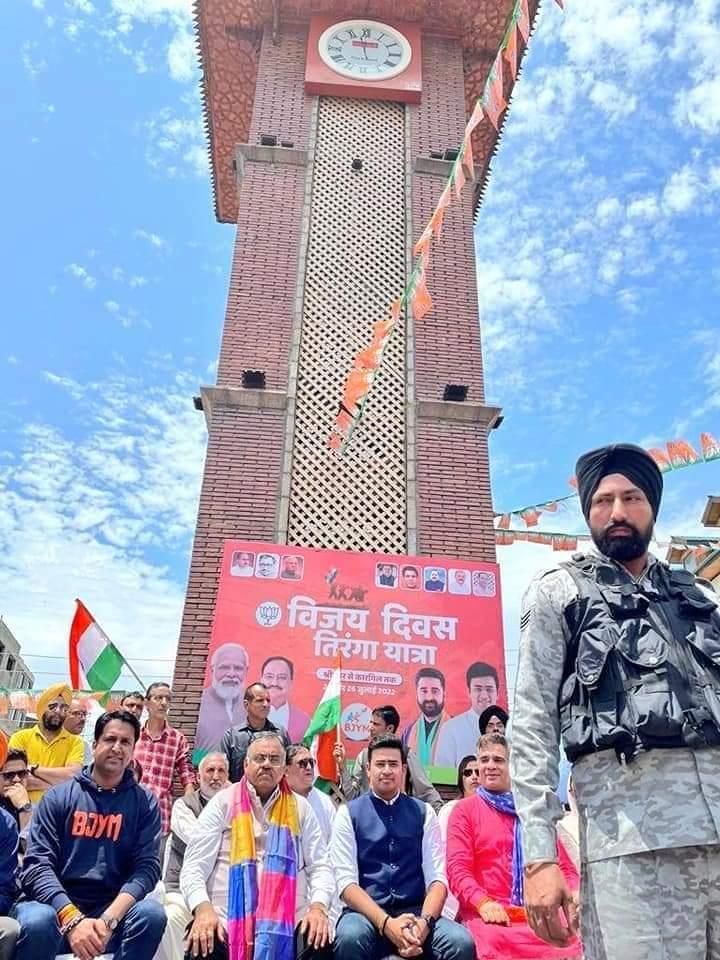
In sharp contrast to a bizarre combination of fear, trauma and melancholy, that the ghost-ridden capital city witnessed on 26 January 1992 when senior BJP leaders Murli Manohar Joshi and Narendra Modi hoisted the Indian national flag in the backdrop of a major bomb blast at the Police Headquarters, the business hub of Lalchowk wore a festive look–30 years later, on Sunday.
As the historic Lalchowk reverberated with the patriotic slogan “Bharat Mata Ki Jai”, BJP’s National General Secretary incharge Jammu & Kashmir, TarunChugh, Bharatiya Janata Yuva Morcha (BJYM) President Tejaswi Surya and the BJP’s J&K President Ravinder Raina flagged off a Tiranga Yatra at the iconic Clock Tower. The rally of over 200 motorcycles, each decorated with the Indian national flag, will culminate in a war memorial event on occasion of the Kargil Vijay Diwas on 26 July.
The rally of tricolour with a number of the enthusiastic female bikers zipped past the bungalows of the former Chief Ministers Farooq Abdullah, Omar Abdullah and Mehbooba Mufti who, in 2019, warned that nobody in Jammu and Kashmir would carry the Indian national flag if the BJP government at the Centre dared to withdraw the erstwhile State’s special status granted through Article 370. Prime Minister Narendra Modi’s party is holding this spectacular event nearly 3 years after it abrogated Article 370, split the erstwhile State into the two Union Territories and withdrew its special status. The event is coinciding with India’s victory and Pakistan’s defeat in a military incursion in 1999, which is celebrated every year on 26 July.
Amid PM’s slogan of “Har GharTiranga” this year, the BJYM President Tejaswi Surya has asked all the participants to carry a tricolour and a handful of soil from the front yard of the martyrs’ homes in their respective states, which shall be dedicated at the war memorial as a symbolic gesture of the immortality of the fallen soldiers in honour their families.
Today’s rally was organised in the peaceful Kashmir valley where transport and other businesses operated smoothly even as the authorities closed all incoming roads around Lalchowk, put in place a thick security bandobast and requested the traders to suspend work for about two hours until the event was finished. No untoward incident was reported from anywhere. With heavy security surveillance, the rally passed through Gupkar Road, Boulevard, Northern Foreshore Road, Ganderbal, Kangan, Sonmarg and Zojila on way to Dras and Kargil.
To simultaneously commemorate the 75 years of India’s independence, as part of the yearlong campaign “Azadi Ka Amrit Mahotsav”, a 75-meter-wide Indian national flag will be hoisted on Tuesday at the war memorial in Kargil which is now part of the separate Union Territory of Ladakh.
The Kargil War was fought between 8 May and 26 July in 1999 against the Pakistani intruders who in the winters of 1998 transgressed into the Indian territory and occupied fortified defences overlooking the strategic Srinagar-Leh highway.
In the thick of Pakistan-sponsored insurgency, then BJP President Joshi and senior party leader Modi organised a rally to hoist the tricolour on the Clock Tower at Lalchowk on the Indian Republic Day, on 26 January, in 1992, a day after a major bomb blast by Hizbul Mujahideen at the PHQ which left the Director General of J&K Police J.N. Saksena and other senior officers, including several ADGs and IGPs, injured.
Tejaswi, Chug and Raina recollected the day in 1992 and compared it with today when, according to them, peace had been restored and terrorism defeated in the 9th year of the BJP regime. They made frontal attacks, not only on the insurgents and rank separatists but also on the valley’s “dynastic rulers”– euphemism for Farooq Abdullah’s National Conference (NC) and Mehbooba Mufti’s Peoples Democratic Party (PDP)– for playing up and promoting Pakistan’s and the secessionists’ narratives. They claimed credit for PM Modi, Home Minister Amit Shah and the BJP for withdrawing support and terminating Mufti’s government in June 2018 and affecting a historic transformation in August 2019 and thereafter.
Surya referred to the high tourist footfall in the current year and said that the largest number of tourists– over 10 million– had visited Jammu and Kashmir in the last 7 months of 2022. Chug asserted that the Central Government under Modi had transformed Kashmir “from the capital of terrorism to the capital of tourism”.
“Mehbooba Mufti had claimed that after abrogation of Article 370, no one will raise tricolor in J&K. Let she visit Lal Chowk and see how everyone has been carrying the tricolor in their hands,” Chugh said, adding that the twin families were claiming high and tall that Article 370 could not be abrogated. “But Prime Minister Modi has made it possible”, Chugh added. He said that the “dynastic rulers” had looted Jammu and Kashmir while their own family fortunes had risen phenomenally.
“J&K has moved forward and it cannot move ahead as per the aspirations of the dynasts,” Chugh told reporters.