
India nominates ‘Maratha Military Landscapes’ for 2024-25 UNESCO World Heritage List
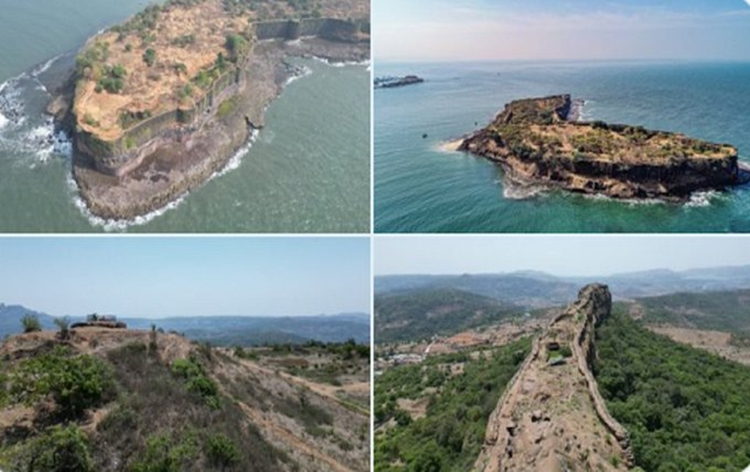
The Ministry of Culture announced that India is nominating the ‘Maratha Military Landscape’ for inclusion in the UNESCO World Heritage List for the 2024-25 cycle, with a total of 12 components included in this nomination. Suvarnadurg Fort is a part of the historic ‘Maratha Military Landscape’.
In its official statement, the Culture Ministry said that the ‘Maratha Military Landscapes’ represents extraordinary fortification and military system envisioned by the Maratha rulers, showcasing the vibrant history of India. It said that the twelve components of this nomination are — Salher fort, Shivneri fort, Lohgad, Khanderi fort, Raigad, Rajgad, Pratapgad, Suvarnadurg, Panhala fort, Vijay durg, and Sindhudurg in Maharashtra, and Gingee fort in Tamil Nadu.
Officials from the ministry said that these twelve components are distributed across diverse geographical and physiographic regions and they shocase the strategic military powers of the Maratha rule in ancient India. The statement said that the ‘Maratha Military Landscapes of India’, which developed between 17th and 19th centuries, “represent an extraordinary fortification and military system envisioned by the Maratha rulers.
It further said that this extraordinary network of forts, varying in hierarchies, scales and typological features, is a result of integrating the landscape, terrain and physiographic characteristics distinctive to the Sahyadri mountain ranges, the Konkan Coast, Deccan Plateau and the Eastern Ghats in the Indian Peninsula.
There are more than 390 forts in Maharashtra, out of which only 12 forts are selected under the ‘Maratha Military Landscapes of India’, and eight of these forts are protected by the Archaeological Survey of India (ASI).
The forts under ASI are Shivneri fort, Lohgad, Raigad, Suvarnadurg, Panhala fort, Vijaydurg, Sindhudurg and Gingee fort; whereas Salher fort, Rajgad, Khanderi fort and Pratapgarh are protected by the Directorate of Archaeology and Museums, government of Maharashtra.