
Articles & OpinionFeature StoriesTrending Photo
Human First, Profit Too: Vatsal Soin Files New 0→1 Doctrine Patents to Steer Singularity-Age AI Past Balance Sheets Two Arché Inventions, the 0→1 Doctrine and BBAT, Band-Based Archive Triage, work alone or together across sectors.
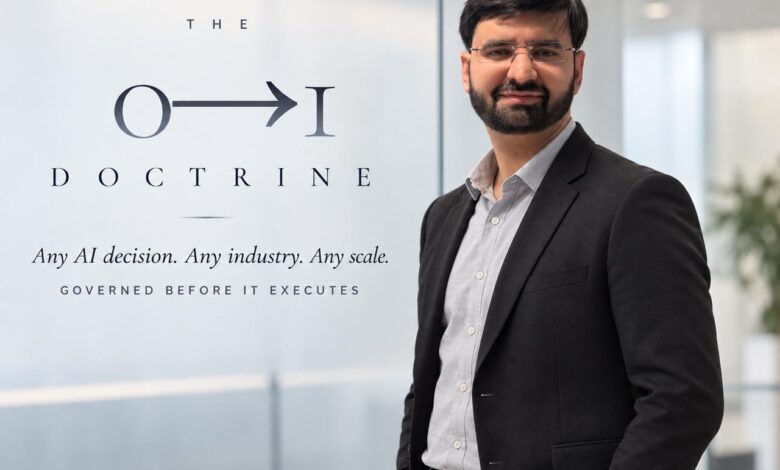
September 23 and October 1, 2026. The Doctrine checks each action against human-set limits before it runs; BBAT sorts dormant archives by metadata and derives protected bands. Aimed at population-scale use and zettabyte data, they aim to make AI accountable toward the Singularity.
LIVE www.0to1doctrine.com
IN ONE LINE
Different fields speak in different units: medicine uses years, kilograms and milligrams; farming uses hectares, tonnes and litres; finance uses rupees, dollars and percentages; energy uses watts, volts and kilowatt-hours. The 0→1 Doctrine proposes a common normalized scale for comparing relevant needs, capabilities and authorized limits without replacing those original measurements. BBAT separately sorts archives into RETAIN, PURGE or PROMOTE; promotion is not permission to release data.
PROFIT WITH PURPOSE
A longer healthy life, safer treatment, accessible services, clean water or food arriving before it spoils: none fits neatly on a balance sheet. Yet each depends on information, resources and decisions. The two inventions propose complementary safeguards: make eligible archives useful through governed analysis, and check consequential actions against human-defined limits before execution. Financial savings may follow. The greatest progress is when humanity and prosperity advance hand in hand.
LOCKED ARCHIVES EVERYWHERE
Hospitals, laboratories, farms and public services hold records that may be difficult to reuse because of privacy, retention and contractual obligations. BBAT first triages archives using metadata rather than opening their contents. It identifies records to retain, route for authorized deletion or promote for separately governed processing.
HOW A BAND IS MADE
For eligible protected data, a Trusted Execution Environment (TEE) can process underlying content and derive useful, bounded signals through DDME. Delete-Before-Share (DBS) controls, privacy tests, attestation and release rules govern what may be transmitted. The resulting bands are designed to preserve useful information without exposing complete underlying records.
RESEARCH AND RARE DISEASES
Across cancer, rare diseases, neurodegenerative conditions and clinical-trial research, useful evidence can be scattered among institutions. Protected derivation and aggregated training signals could support analysis of eligible historical outcomes without exchanging source patient files. Whether those signals improve research or drug discovery must be tested against scientific utility, privacy attacks and clinical safeguards.
PANDEMICS
During an outbreak, institutions need timely, representative evidence. Aggregated signals derived from eligible records could help researchers examine trends without exchanging the underlying patient files. Such signals would complement—not replace—validated epidemiological surveillance, laboratory confirmation and public-health judgment.
BIOLOGICAL AGE, NOT JUST BIRTHDAYS
Calendar age counts years lived. Biological age estimates how the body is doing, using health measures such as blood tests. The 0→1 Doctrine turns a person’s validated test results into bands and checks them against clinician-approved ranges: approve, reject or hold. People could gain care fitted to the body, not the birthday. BBAT could help researchers test which measures matter. Neither promises extra years.
DIETS AND NUTRITION
Children, adults and older people have different nutritional requirements, allergies, medical constraints and preferences. The 0→1 approach could represent measurable needs and food capabilities in comparable bands to support diet planning and nutritional allocation. Dietary choices still require appropriate professional advice, consent and context.
FOOD, FARMS AND WASTE
Food spoils, water is lost, farm inputs are misallocated and medicines expire. Within the wider 0→1 framework, the Fair & Transparent Waste Estimator (FTWE) proposes comparing estimated waste with later recorded outcomes. Together with governed matching of needs and available supply, such methods could support decisions about agriculture, food distribution, water and energy. Actual reductions would require field measurements and independent validation.
EVERY AGE AND ABILITY
A child needing age-appropriate support, an older adult living independently and a person using an assistive device may all be poorly served by one-size-fits-all allocation. Measurable needs and service capabilities could be compared before a decision. Disability rights, consent, accessibility and lived experience remain human judgments—not numbers to be optimized away.
BEYOND THE CLINIC
The same pre-execution question arises in finance, electricity grids, flood response, climate interventions and space operations: does a proposed action satisfy the applicable, expert-approved limits? The 0→1 Doctrine proposes authorization checks before execution. Separately, BBAT’s Cross-Agent Aggregation Detector (CAAD) examines sealed receipts for possible collective risk patterns; its warnings call for investigation, not automatic proof of wrongdoing.
THE BIRD’S-EYE VIEW
ALONE OR TOGETHER
The inventions do not depend on one another. A hospital can triage archives with BBAT without deploying 0→1 action governance; a clinic can govern treatment authorization without opening old archives. Where both are appropriate, governed information may inform a separately authorized decision. Each stage needs its own permissions, tests and accountable operators.
LAYERS OF THE INVENTIONS
The Doctrine: needs, supply and limits become bands from zero to one. A match is gated before action, and an Actuation Compliance Receipt (ACR) is sealed before it runs. Around that chain sit supervisory layers: the Predictive Risk Advisory Token (PRAT) issues an advisory as drift builds; the Emergent Meta-Environmental Response and Governance Envelope (EMERGE) reads aggregated, privacy-preserved signals for systemic risk; and the Post-ACR Remediation and Resolution Framework (PARR) governs corrective action afterwards.
BBAT: archives are sorted by metadata, and the Metadata Inconsistency Check Module (MICA) catches incomplete or conflicting labels instead of proceeding. A sealed machine derives bands, wipes first and releases only bands, with checks that rise with risk, while the CAAD reads receipts for shared risk.
TOWARD THE SINGULARITY
AI is gaining speed and autonomy. Two questions follow: what data may it learn from, and what action may it take? BBAT answers the first, the Doctrine the second, and both leave sealed receipts. The aim is accountable AI as it nears the Singularity, with people holding the final say.
CLEARLY EXPLAINED
What does a data owner gain?
Analysis from bands without sending source files out, plus a record of every decision.
Who makes the final call?
A named person. The system narrows the options and records the reasons.
Must both be used together?
No. Each stands alone; together, one governs the data and the other the decisions drawn from it.
How would a pilot begin?
One archive, one question. Compare governed and ungoverned work on usefulness, privacy tests, waste and auditability.
CLOSING NOTE
Superintelligence or Singularity will be valued by what it earns and judged by what it protects. Give it limits to honour and records it can trust, and capital and conscience grow together.
LIVE www.0to1doctrine.com
This can be tested, live, via API, governed against ungoverned, side by side.
THE INVENTOR
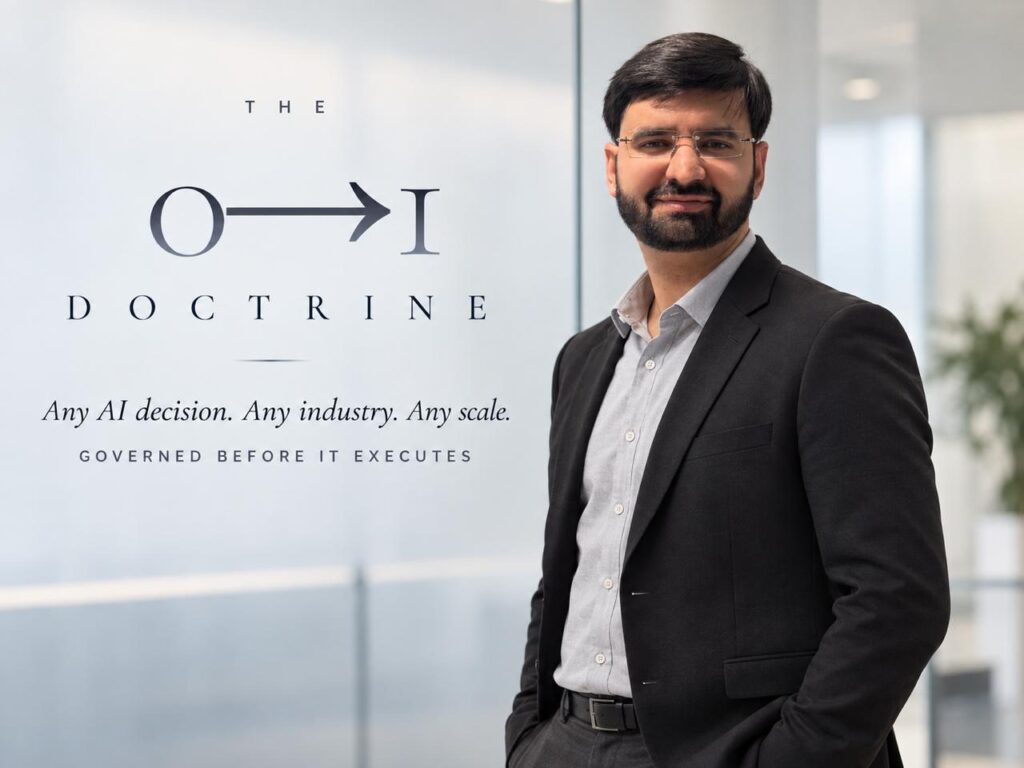
Systems theorist, inventor, and serial entrepreneur Vatsal Soin holds grants in the US, Japan, India and more; filings span six continents; latest grant, AI footwear, August 2026. Inventions: footwear, apparel fit, Sharable Size Cards, digital twins, robotics, global governed data, archive triage, quantum-resilient cryptography, AI governance. SIM–RMIT and NTU alumnus. Every prior invention was a step; 0→1 is the destination.
SELECTED REFERENCES
Granted: US Patent 12,446,652 B2 · Japan Patent 7560909 · India Patents 454081 and 599317. Filed: PCT/IN2025/051943 · US 19/489,595 · India 202511115781 · Australia AU2022450649 · India 202611113867 (23 September 2026) · PCT/IN2026/052042 (1 October 2026).
DISCLAIMER
Informational only. Not certified. No endorsement implied. Not investment advice. Examples are illustrative, not field results. Vatsal Soin · © 2026 All Rights Reserved.