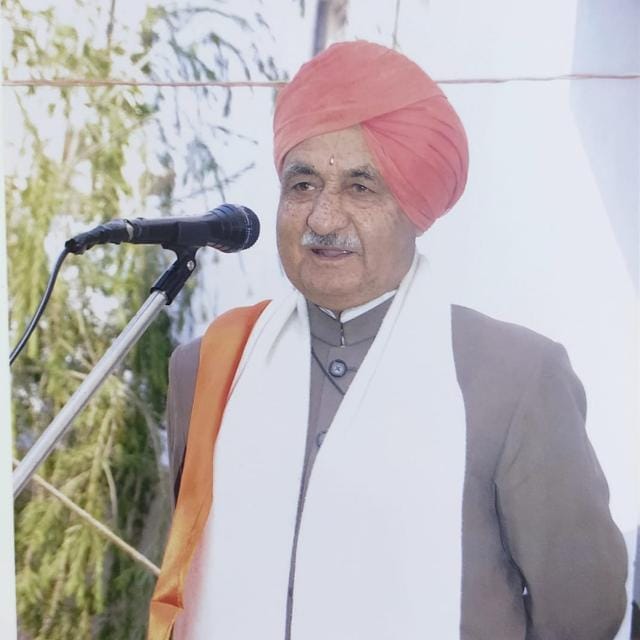

A Young Girl’s Reflection: Shri Amarnath Vaishnavi Lives On
How a Legendary Social Worker Continues to Inspire the Youth of Today

Diksha Mirza ( MBBS Student)
Introduction: A Legacy Forged in Struggle
There is nothing new about the struggles of Kashmiri Pandits in Kashmir—struggles brought about by socio-political turmoil over several centuries, resulting in multiple exoduses from the valley. Yet, here we are—still surviving and growing, both individually and as a community.
This remarkable state of consistency and perseverance, while standing the test of time, has been made possible by the contribution and support of various leaders. Among them stands the great Shri Amarnath Vaishnavi Ji.
After reading about the life journey of this legendary figure, I was truly mesmerised by his activism and the profound way in which he positively impacted the lives of lakhs of people. Reflecting on his life is a mammoth task, given the vast scope of his contributions as an octogenarian. However, I feel it is my responsibility to share a few of my personal learnings from his journey—for the greater good of society at large.
Stepping in his footsteps of selfless service as a doctor is my dream, and I hope that through my learnings from his life, I am able to inspire many other youngsters to walk in his shoes.
Living with Integrity: A Life of Selfless Devotion
Shri Amarnath Vaishnavi Ji’s whole life is a tale of how he selflessly worked for the well-being of the Kashmiri Pandit community without any personal benefit.
Very few people in this world think about the preservation of the roots of their culture and community. He always kept his community before anything else.
After the exodus of the Kashmiri Pandit community, Shri Vaishnavi Ji met the governor of the state to demand monthly financial assistance on the Punjab pattern for the victims of Kashmir who were forcefully displaced.
The governor called a meeting, and it was decided that the financial assistance given to Punjab victims would also be followed by J&K, and it continues to this day.
Resilience and Vision: The Do not give up attitude
Shri Vaishnavi Ji had great vision. He observed that Kashmiri Pandit children were not well accommodated in educational institutions in Jammu. He thought of creating opportunities outside the state.
He knew the importance of good education and how education could change lives for the better.
He headed to Mumbai along with Mr. Hiralal Bhat and met the Shiv Sena leadership to convince them to offer reservations in Maharashtra. After days of repeated meetings and convincing, they finally achieved success.
His attitude of consistency, conviction, and self-confidence were his best assets. He was not one of those people who had a give-up attitude towards life.
Life is never a bed of roses. Every day is not the same. Not everyone will have the same opinion as yours. Not everyone will listen to you.
But if one knows they are right in what they are doing, then there should be no going back. Many forces will try to pull us back, but to resist them and come out as a star is the sign of a great soul and a great leader.
Shri Amarnath Ji was very selfless, optimistic, bold, and true to his words.
Courage in Crisis: The Power of a Fearless Mind
Shri Amarnath Vaishnavi was known to be bold and fearless. He had a great presence of mind.
During the Praja Parishad movement in the early 1950s, he was given the responsibility of escorting people to Narot Jaimal in Pathankot, from where the crowds had to cross over to J&K to protest against article 370 and the lack of integration of J&K with India. The police was already suspicious of him and kept a vigil over him. He was witty enough to trick the officials by sitting by the side of a lake throughout that day , eating mangoes. Police kept an eye on him, not suspecting that he had got the job done, in parallel, while keeping the police engaged and letting his colleagues complete the task.
Another time, when he knew he was anticipating arrest, instead of crossing the bridge where police officials were standing and waiting for him, he jumped into the Jhelum River and crossed over to the other side ,escaping the police. He met his friend on the other side, who had kept his clothes safely with him. His sharp mind always helped him in tough situations.
Not only can knowledge guide an individual in times of crisis, but also their presence of mind and the ability to make quick and bold choices can help one survive the toughest circumstances. Challenges in life are always going to be tricky, and one should train their mind to take decisions consciously and for the benefit of all.
All these qualities were present in Shri Amarnath Vaishnavi Ji, which made him an exceptional leader and a beautiful person at heart.
Learning by Leading: A Life Devoted to Knowledge
It is generally stated that “Every person has something to give; you must know how to take it.”
The Tale of Sharing Knowledge
Shri Amarnath Ji was a teacher by profession. He rejected fancy government jobs to fulfill his dream of becoming a teacher. The Kashmiri Pandit community has always stood by the principle of education and learning, even in times of hardship—and so was his thought.
What better way to bring reformation in society than by teaching? He knew that for shaping a bright future for society, teaching would be the best way possible. The young generation should comprehend from this that knowledge is power. Knowledge absorbed and distributed among others is the best weapon at all times.
Conclusion: Honouring the Past, Inspiring the Future
Today, the Kashmiri Pandit community lives across many states in India and overseas, but remains connected through the strings of culture, customs, language, and love. The young generation is growing and completing their education, that too in good institutions—all because of Vaishnavi Ji.
As human beings, should we not think of giving back for all we have received—and more—to our community?
People listen, grow, and move on, but those who understand the real atrocities that the Kashmiri Pandit community has faced throughout time would stay close to their culture and support the upcoming generations.
These stories and tales should not be confined only to us.
They should be known to all those who will come, and should inspire them to reciprocate the same.