

Where are 92 pumps on which govt spent Rs.150 Cr of National Saffron Mission?
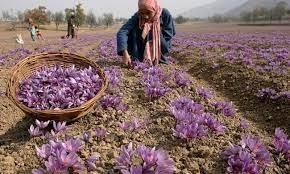
Officers of the Union Territory’s Agriculture Department and engineers of the Jammu and Kashmir Mechanical Engineering Department have failed to make functional 92 water pumps on which the Government of Jammu and Kashmir has spent Rs.150 crore of the National Saffron Mission for boosting the saffron production.
Different delegations of the growers complained to The News Now that out of the total funds of Rs.377 crore received from the National Saffron Mission (Phase-I), an amount of Rs.150 crore had been paid to the Mechanical Engineering Department for providing 92 high-calibre water pumps for sprinkler irrigation of the saffron fields of Pampore.
“They (engineers of the Mechanical Engineering Department) claimed an expenditure of Rs.100 crore on the pumps and Rs.50 crore on the supply lines. The Chief Engineer gave an undertaking of making all the 100-odd pumps functional last year. But not a single pump was functional this year”, said a prominent saffron grower of Chandhar, Pampore. “Had the promised pumps been made functional, our produce would have doubled this year”, he added.
While officials of Kashmir Agriculture Department claim production of 13 metric tonnes, the growers invariably put the estimated figure between 7-8 MTs in 2022 as compared to 6-7 MTs in 2021. “The increase of around one metric ton this year is due to the rains at a crucial time before the harvesting”, said Mohammad Shafi, a grower from Pampore. “This is not a bumper crop as the officials claim. This is nothing when compared to the produce we had 10-12 years back”, he said.
While the senior officers of the two departments could not be reached for their comment, incharge of the e-Auction Centre at Indian International Trade Saffron Spice Park at Dussu, Pampore, Muzamil Salmani, said that the collection process was still in progress. He is expecting a marginal increase in the saffron produced this year as compared to the last year. Salmani and almost all other officials at the Rs.40 crore quality control testing laboratory and trade centre and the growers said that the marginal increase would be only due to the rains on time this year.
“Fortunately due to the timely rains, a drought emergency did not occur this year. Yes, the pumps shall have to be made functional as a drought could prove disastrous any time in the future”, Salmani said. He maintained that he was not the right person to speak on why the pumps had not been made functional for the growers despite repeated assurances by the Agriculture Department.
According to Salmani, 1500 growers have visited the e-auction centre at Dussu in the last three weeks. “The collection season is still underway. It has been extended due to high inflow of the aspirants”, Salmani said. All the required facilities, including quality control testing, packaging, labelling, GI tagging and e-marketing are available at the centre. As compared to the local market rate of Rs.130-150/gram , the e-auction centre is getting the growers Rs.200-220/gm. “Mongra (super refined saffron) is now selling at Rs.350/gram”, said another official. He said that the e-auction centre had fixed the minimum rate of Rs.225/gram.
While the officials are expecting Rs.400 crore, most of the growers insist that this year’s produce would fetch them a total of Rs.200-240 crore. Now Kashmir Agriculture Department is demanding another fund of Rs.385 from the Union Government for Phase-II of the National Saffron Mission.
The Pampore area of Kashmir enjoys the distinction of producing the world’s best quality saffron, even as Iran continues to be the largest producing country. Safranal (aroma strength) and Crocin (colouring strength) and picrocrocin determine the quality of the saffron.
While 200 is the standard colouring power (crocin) of Grade-I saffron, the saffron produced in Pampore has crocin between 280 and 300. Safranal for Grade-I must be 20. The Pampore saffron has 40-50 as compared to 20 of the Iran saffron. “The best quality saffron dissolved in water has yellow colour. If it is red, it is adulterated with a chemical”, Salmani said.
This Rs.40-crore facility with a quality control laboratory has been created by the National Horticulture Board under National Saffron Mission, mainly to help the growers maintain the quality and get the best possible price of their produce in the domestic as well as international market. Its foundation stone was laid by the then Union Agriculture Minister Radha Mohan Singh in August 2014. It was made fully functional in 2020.
According to the Minister, it was a matter of major concern that the area under saffron cultivation in Kashmir had declined from 5,707 hectares in 1996 to 3,875 hectares in 2010-11, bringing down production from 3.13 kg/hectare to 2.47 kg/hectare. In the last 8 years, it has further reduced—according to officials to 2,000 hectares but according to the growers to just 1,200 to 1,500 hectares.
“We are still far below the levels we had achieved over 10 years back but if you compare the production of the last 4 years, we have improved in 2021 and 2022”, Salmani asserted.
Kashmiri Saffron is grown at an altitude of 1,600 m to 1,800 m above mean sea level, which adds to its uniqueness and differentiates it from other saffron varieties available across the world. The spice is also grown in smaller quantities in some areas of Budgam, Kishtwar and Srinagar regions of Jammu & Kashmir.
Iran is the largest producer of saffron in the world and India is a close competitor. However, with the GI tag of Kashmir saffron, India becomes the only saffron producing country for which GI has been assigned which will result in more prominence in the export market thereby boosting exports as well as helping the farmers to get the best remunerative price for economic sustainability.