
Exile Had a Guardian. His Name Was Pandit AmarNath Vaishanvi Ji
By Rahul Kilam #KilamsCorner
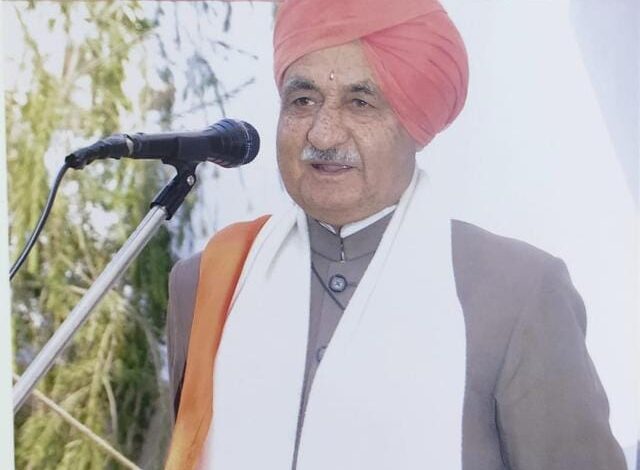
In the history of every oppressed people, a few individuals rise above time, politics, and circumstance. Their presence becomes synonymous with courage, sacrifice, and hope. For the exiled Kashmiri Pandit community, Pandit Amar Nath Vaishnavi, lovingly known as “Lalla Ji”, was that soul.
Born on August 24, 1925, in Jammu & Kashmir, Lalla Ji stood as a moral and spiritual anchor for his people through decades of upheaval. A teacher by profession, he believed that true change could only come by nurturing and inspiring the youth. He joined the Rashtriya Swayamsevak Sangh (RSS) in 1945 and eventually became the Sanghchalak for Kashmir and Ladakh, playing a pivotal role in expanding the Sangh’s work in the region. He was not merely a leader—he was a torchbearer of collective identity. Whether during the Praja Parishad movement (1949–1953), the Ladakh Buddhist movement of 1968 where he helped prevent forced religious conversions, or the Kashmiri Pandit agitation of 1967, Lalla Ji led from the front with conviction and compassion. Born not just of a time, but of a purpose, Pandit Amar Nath Vaishnavi was more than a man—He was a compass when the map was lost. A teacher, a thinker, a flame that warmed cold hearts and lit the path for generations wandering in the dark. In classrooms, he sowed ideas. In Sangh Shakas, he raised swayamsewaks. In temples, camps, protests, and prayer halls, His voice thundered—“Jaikara….Har Har Mahadev!” Not in anger, but in faith. Not to divide, but to awaken. When the exodus of Kashmiri Hindus took place in the 1990s, forcing thousands from their ancestral homes, Vaishnavi Ji didn’t stand apart—he stood among them. From Geeta Bhawan, he provided not only physical support but emotional stability to a people on the verge of despair. His readiness to act, his relentless presence, and his sacrificial living made him a symbol of resilience.
He also served as the Vice President of the J&K State BJP in 1990 and contested elections in 1996 from the Srinagar Constituency, but his stature far exceeded political boundaries. Leaders across parties respected him as a man of rare integrity and vision—a saint in the garb of a commoner. Despite his towering contribution, Lalla Ji lived a life of simplicity, spending his final years in a modest camp room, just like thousands of displaced Kashmiri Pandits. He never sought personal gain, fame, or comfort.
He lived and breathed only for his people.
They called him “Lalla Ji.”
Then they called him “Vaishnavi Ji.”
Then, in whispered reverence,
“The Father of the Community.”
Such was the love and reverence for him that after his passing, the community began to call him “Father of the Community”. The name wasn’t given—it was earned, etched in the collective memory of a people who saw in him the embodiment of sacrifice, spirituality, and selfless service. Today, Lalla Ji is not just remembered—he is revered. His teachings, his example, and his unwavering commitment continue to guide the Kashmiri Hindu community, reminding them that in the face of darkness, it is possible to be the light. Wearing the Turban (Dastar) of simplicity, eating little, sleeping less, yet offering all he had—his time, his truth, his soul.
Pandit Amar Nath Vaishnavi, known in every household, remains not just a figure from the past, but a living inspiration for all those who believe in truth, justice, and the power of selfless service.
Let Us Not Just Remember—Let Us Reflect. In times like ours, when identity is fractured, And truth is a tired soldier, We look back at Vaishanvi Ji not to mourn,
But to relearn:
“How to live without hate.
How to fight with faith.
How to serve without being seen.
How to rise while kneeling in prayer.”