
EntertainmentFeature StoriesJammu & KashmirTrending Photo
From Jammu to the World: How Vomedh Created Jammu’s First International Film Festival and Built a Global Cinema Movement
There are cultural events that entertain a city, and then there are cultural interventions that fundamentally alter how a city sees itself and how the world begins to see that city. For Jammu, one such moment arrived in September 2019, when Vomedh, led by brothers Rakesh Roshan Bhat and Rohit Bhat, created the first-ever international film festival in Jammu. Until then, Jammu had no shortage of artistic talent. It had theatre, actors, writers, filmmakers, technicians, storytellers and a deeply rooted cultural tradition, but it lacked an international cinema platform that could connect this talent with filmmakers, institutions and audiences beyond the region. The Jammu International Film Festival changed that equation. It was not merely another cultural event on the city’s calendar; it was a declaration that Jammu could host, curate and sustain an international cinematic platform of its own.
The inaugural festival, held in September 2019, brought together 37 short films and documentaries from 11 countries, alongside projects by filmmakers from Jammu and Kashmir. More than 150 entries from around 15 countries had reportedly been received for the very first edition, an extraordinary response for a festival that had no previous edition, no inherited institutional structure and no established international reputation to rely upon. Film and television personalities including Kashmira Shah, Ayub Khan and Ayaz Khan came to Jammu, while eminent theatre personalities such as Mushtaq Kak and Lalit Parimoo became associated with the initiative. Workshops and interactions added another dimension to the festival, ensuring that the event was not limited to film screenings but also became a space for learning, exchange and exposure for aspiring artists. For the first time, Jammu was not merely consuming cinema produced elsewhere; international cinema had come to Jammu, and Jammu’s own filmmakers were being placed within that larger conversation.
The vision behind the festival was equally important. Rakesh Roshan Bhat had consistently articulated the challenge facing Jammu’s creative fraternity: the region possessed talent but lacked adequate professional platforms, structured exposure and meaningful access to the wider film ecosystem. The objective was therefore larger than organising a two-day festival. The ambition was to place Jammu on the global map of arts and cinema and to create an institutional platform through which local talent could interact with national and international filmmakers. Rohit Bhat similarly described the festival as an expression of the aspirations of Jammu’s art- and cinema-loving population. Seen retrospectively, those statements were not ceremonial declarations. They became the blueprint for what followed.
The real significance of the 2019 festival became visible in subsequent years. Many cultural events make an impressive debut and then disappear. The Jammu Film Festival did the opposite. It returned, expanded and began acquiring institutional recognition. By its second edition in 2022, the festival had the support of the Directorate of Tourism, Jammu, and featured around 40 international films from 15 countries along with regional cinema. This represented more than an increase in numbers. The festival had begun to intersect with tourism promotion, cultural branding and the larger effort to present Jammu as a destination in its own right. Through cinema, locations across the Jammu region could be projected to filmmakers and visitors, while the city itself began developing an identity associated with an international cultural event. Jammu was no longer being positioned merely as a transit point or gateway; the festival helped establish the idea of Jammu itself as a creative destination.
What followed demonstrated that Vomedh’s vision was not geographically confined to one city. The experience created in Jammu became the foundation for another ambitious initiative in Srinagar. Vomedh subsequently developed The International Film Festival of Srinagar, popularly known as TIFFS, extending the film-festival ecosystem across the Pir Panjal. The first editions of TIFFS brought international and regional cinema to Srinagar’s historic cultural spaces and created a similar environment where filmmakers from Jammu and Kashmir could share a platform with cinema from other parts of India and the world. By the second edition in 2023, films from numerous countries were being screened, and the awards ceremony at Tagore Hall was attended by Lieutenant Governor Manoj Sinha, who publicly appreciated Vomedh’s contribution to theatre, culture, language and cinema in Jammu and Kashmir. That recognition was significant. What had begun in 2019 as an independent cultural experiment in Jammu was steadily becoming an acknowledged cultural institution.
The most powerful expression of this transformation came in 2024, when the Jammu Film Festival and The International Film Festival of Srinagar were brought together as a joint Jammu-Srinagar edition. The scale had changed dramatically. The organisers received approximately 400 entries from 50 countries, from which 78 films representing 29 countries were selected, including short films, documentaries and feature films. The festival opened in Jammu and subsequently travelled to Srinagar, effectively creating a cinematic bridge between the two principal cities of the Union Territory. Lieutenant Governor Manoj Sinha inaugurated the joint edition in Jammu and lauded Vomedh’s efforts in promoting cinema in the region. In just five years, the trajectory had moved from Jammu hosting its first international film festival to Jammu and Srinagar jointly participating in a festival ecosystem attracting entries from dozens of countries.
This transformation is precisely why the Jammu Film Festival must be understood as more than a sequence of annual events. Its deeper achievement lies in creating continuity. It established a platform where none existed, developed an international network around that platform, gave local filmmakers access to audiences and professionals they might otherwise never have encountered, and gradually expanded the geographical and cultural footprint of the initiative. It also demonstrated that major cultural institutions do not always have to emerge through government machinery or large corporate structures. Sometimes they begin with a small team, a clear cultural conviction and the willingness to take a risk in a city that has never hosted such an event before.
The growth of Vomedh’s wider media and cultural ecosystem also contributed to this journey. The Right News, launched by the Vomedh group in 2020, emerged after the inaugural Jammu Film Festival and therefore was not the founding organiser of the first edition. The historical credit for creating Jammu’s first international film festival belongs to Vomedh. However, The Right News subsequently became an important part of the larger ecosystem around the initiative, documenting cultural developments, highlighting festival editions and helping take stories from Jammu to digital audiences far beyond the physical venues where these events were being held. Cinema, theatre, journalism and digital communication increasingly began operating as interconnected elements of a broader cultural movement.
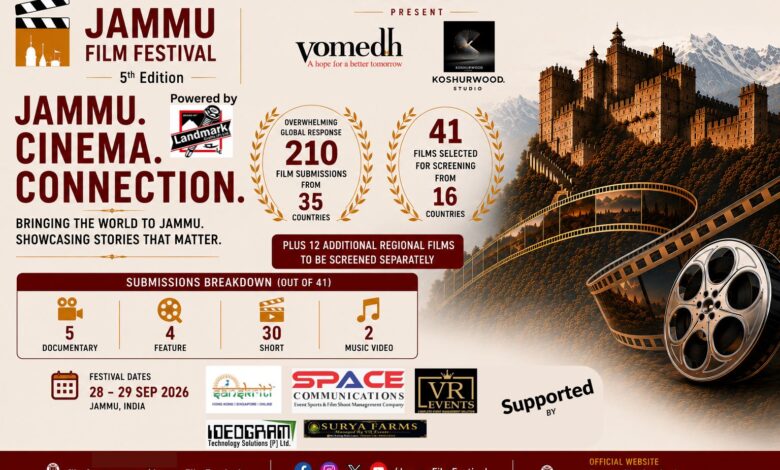
By 2026, the strongest evidence of the festival’s success is its survival and expansion. The Jammu Film Festival is moving towards its fifth edition, and even before the completion of the submission process, it had reportedly attracted around 180 film entries from 35 countries. That journey must be viewed against where it began: 37 selected international films and documentaries from 11 countries in 2019. Within a few years, the festival ecosystem created by Vomedh had expanded across Jammu and Srinagar, attracted hundreds of entries from across the world, hosted recognised personalities from cinema and theatre, received institutional acknowledgement and created a recurring platform for regional filmmakers.
Perhaps the most accurate way to describe Vomedh’s contribution is this: it did not create Jammu’s talent; Jammu always had talent. What Vomedh created was a platform capable of presenting that talent to the world. Before 2019, Jammu had artists, filmmakers and storytellers but no international film festival of its own. After 2019, it had an institution around which an international cinema culture could begin to develop. The journey then moved from Jammu to Srinagar and from the region to filmmakers across continents. What started as a pioneering festival at Abhinav Theatre became a continuing international cultural movement. The first edition proved that Jammu could host an international film festival. The editions that followed proved that the platform could grow, endure and expand. And in doing so, Vomedh achieved the ambition that had been articulated at the very beginning: it helped place Jammu firmly on the international map of cinema and cultural exchange.