
Anti-encroachment drive spearheaded across J&K
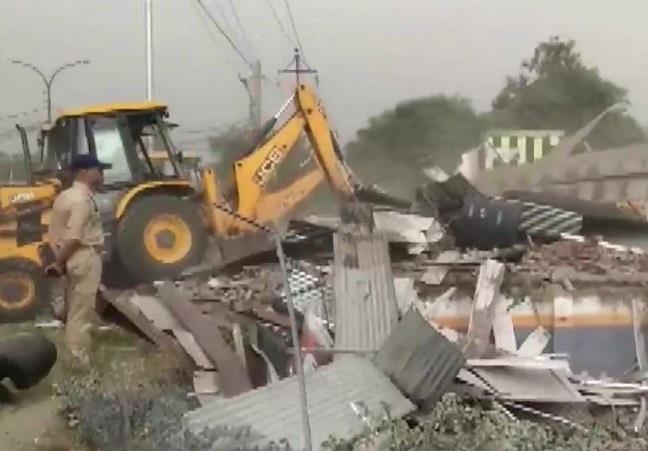
Following the directions from administration led by Lieutenant Governor Manoj Sinha, the concerned authorities spearheaded anti-encroachment drives across the Jammu and Kashmir to retrieve state land.
Moreover, the administration has formulated comprehensive plan to retrieve state land -Teshil wise.
“We have been directed to retrieve all the encroached state land at the earliest. In this regard, plans formulated and deadline has been set for retrieving 100 percent Kachari land by January 31 and Roshni land by April this year,” an official privy with development told The News Now.
He informed that as per the plan, revenue officials on Sunday retrieved 24 kanal and 16 marlas of state land allotted under Roshni Act in village Pandorian in Bishnah.
“The Police party of police station Bishnah along with Tehsildar Bishnah and revenue staff conducted an eviction drive and retrieved 24 kanals 16 Marlas state land falling under Khasra no.638/639/640/641/642/643/644/766/767 situated at village Pandorian, Bishnah,” he added.
Later, the revenue officials installed a sign board bearing state land on it.
“The state land measuring 8565.40 hectares was transferred under Roshni Act 2001 to individuals, institutions and entrepreneurs. The mutations attested in favour of beneficiaries under the said Act have been cancelled and entries in the revenue record have been expunged. Land measuring 1363.95 hectares has been retrieved so far”, said a revenue officer.
In a circular issued on January 9, Commissioner Secretary of the Revenue Department, Vijay Kumar Bidhuri directed all deputy commissioners to ensure 100 per cent removal of encroachments from state land, including Roshni and Kahcharai, by the end of January.
Pertinently, the Roshni Act was passed in 2001 by the then Jammu and Kashmir government led by Farooq Abdullah with the twin objectives of generating resources for financing power projects and conferment of proprietary rights to the occupants of state land. The Roshni Act was formerly known as the J&K State Lands (Vesting of Ownership to the Occupants) Act, 2001.
The Roshni Act initially envisaged conferment of proprietary rights of around 2.055 million kanals (102,750 hectares) to the occupants of which only 15.85 per cent land was approved for vesting of ownership rights. The proceeds were to be used for hydropower projects for generating electricity, hence the name, Roshni (meaning light).
The act was believed to be a revolutionary step in the history of Jammu and Kashmir after the Agrarian Reforms Act.
It was passed by the Jammu and Kashmir legislature in 2001 to confer ownership rights on occupants of State land to raise Rs 25,000 crore for hydel projects, but only Rs 76 crore had been raised from the transfer of encroached land between 2007 and 2013.
The scheme was repealed by the then governor Satya Pal Malik on November 28, 2018. Later, the High Court, while acting on PIL, scrapped the Act and directed the authorities to retrieve the land from the occupants.
According to the Act, the ownership rights of a land would be transferred to its occupants on the payment of a fee fixed by the government, and 1990 was fixed as the cut-off date for encroachment on state land.
The CAG report in 2014 highlighted irregularities in the Roshni scheme, and called it a ‘scam’. The Act was alleged to promote corruption and the unauthorised occupation of public lands in J&K.
The Jammu and Kashmir administration named several politicians, bureaucrats, and businessmen officials as “illegal land encroachers” in the Union Territory under the Act. The report alleged that the reduction in prices of the land was done in a manner that benefited politicians and influential people.
In October 2020, the High Court ruled the Act as unconstitutional, illegal and unsustainable.